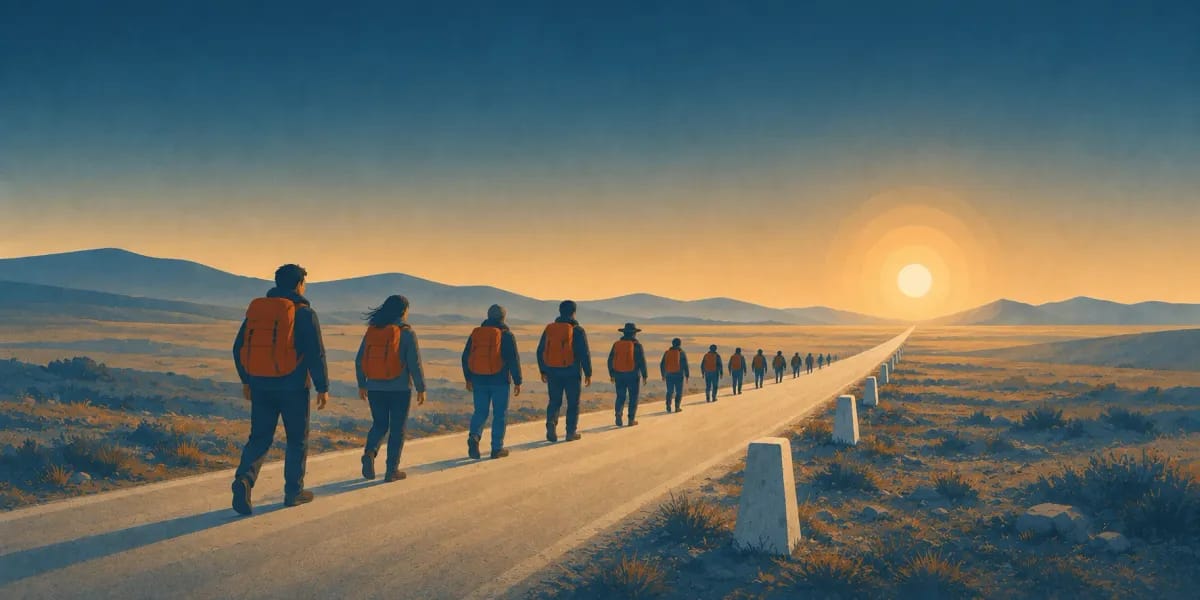
How fast armies marched
How far could an ancient army march in a day? Two old sources give unusually concrete answers.
Roman recruits marched 20 miles in five summer hours
Vegetius, a late-Roman writer, describes how recruits were trained: "Militari ergo gradu XX milia passuum horis quinque dumtaxat aestiuis conficienda sunt" — at the military step, 20 Roman miles were to be covered in five summer hours. At the faster "full step", 24 miles in the same time. And recruits were to carry loads "usque ad LX libras", up to 60 Roman pounds, marching at the military step.
In today's units
| Vegetius | Today | Basis |
|---|---|---|
| 20 Roman miles | ≈ 29.6 km | 1 mile ≈ 1.48 km |
| 60 Roman pounds | ≈ 20 kg | 1 pound ≈ 322–329 g |
| 5 summer hours | ≈ 6:15 h | summer hour ≈ 75 min |
A Roman hour was one twelfth of daylight, so it was longest in summer, about 75 minutes at the solstice.
Athens' army marched straight back from Marathon
Herodotus tells what the Athenians did after the battle of Marathon in 490 BC: they "marched back to defend the city as fast as their feet could carry them" and got there before the Persian fleet. The road from Marathon to Athens is roughly 40 km.
The dying runner is a later legend
The famous messenger who ran from Marathon to Athens and died is not in Herodotus. Herodotus does tell of Philippides, a long-distance runner who was sent from Athens to Sparta before the battle and arrived there the day after he left. The Marathon-to-Athens story only appears in much later writers.
You can train for the Roman step
Rucksteady Premium includes a plan built on these numbers: the Roman legion (29.6 km with 20 kg in 6:15 h). It follows the same safe step-by-step rules as every other plan.
Sources
- Vegetius, Epitoma rei militaris, book I, chapters 9 and 19 (Latin text). (accessed 2026-10-20)
- Herodotus, Histories 6.105–6.106 and 6.116 (trans. A. D. Godley). (accessed 2026-10-20)
- Ancient Roman units of measurement (Roman mile, libra). (accessed 2026-10-20)
- Roman timekeeping (length of the Roman hour). (accessed 2026-10-20)